
More than oil
Moving energy – the Norwegian gas adventure
By the 1970s, it was already clear that petroleum operations on the Norwegian continental shelf were about more than oil. Most reservoirs also contained natural gas, which posed entirely different challenges.
Oil could be recovered, stored and sold into an established international market. It could be carried by ship using existing infrastructure and traded whenever prices were favourable. Gas, by contrast, required pipelines, compressors and receiving facilities before it could be sold, and had limited value until that infrastructure was in place.
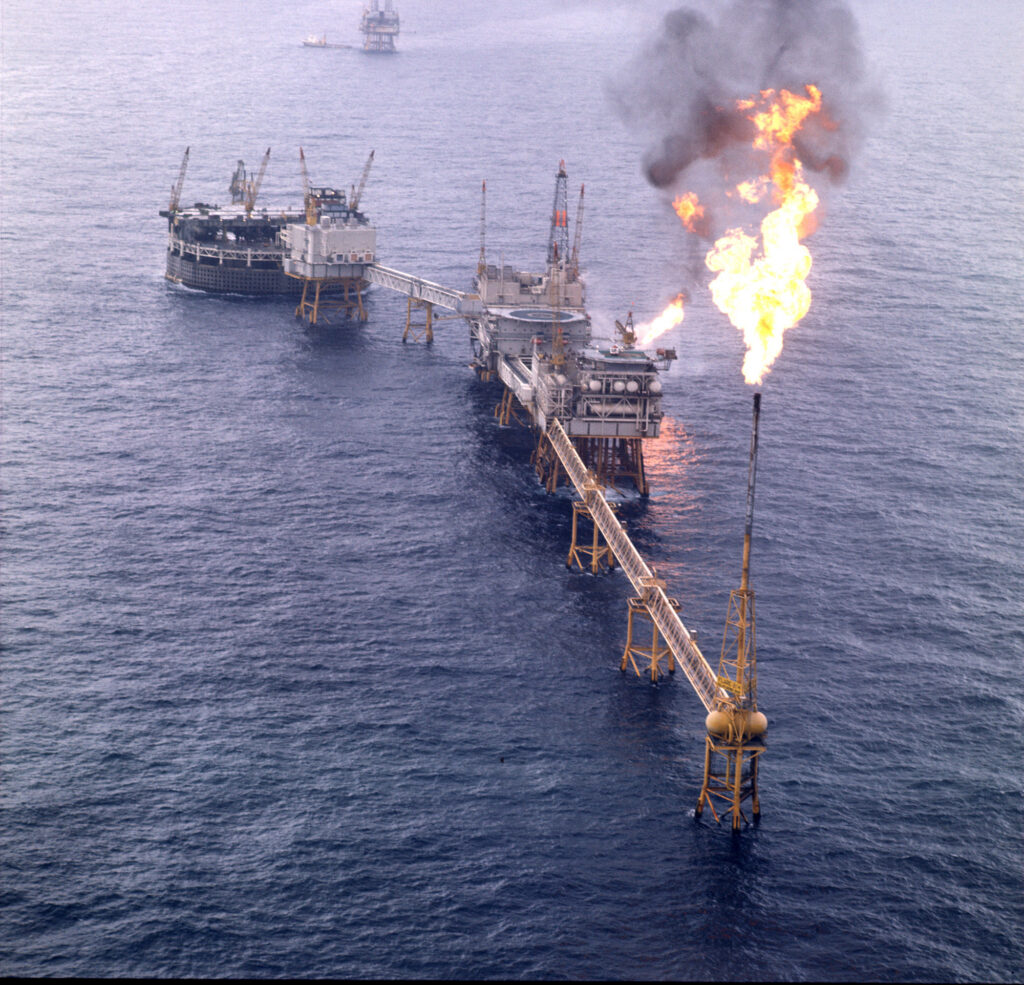
An industry saying of the time summed up the difference: “oil is cash, gas is trash”.
That attitude shaped how Norwegian gas was treated in the early years. It was used on many fields as part of reservoir management by being injected back into the subsurface to maintain pressure and increase oil recovery – a well established practice internationally. This improved total extraction while in effect storing large volumes of gas for later use.
A recognition gradually emerged that gas also had to be handled differently in commercial terms. While oil would always find buyers on an ongoing basis, gas needed to be sold before it could be produced. Long-term contracts, often lasting several decades, had to be negotiated in advance. Costly pipelines and onshore facilities could not be built without knowing a market was available. That was summed up in a principle which would shape Norwegian petroleum policy for many years:
“Find oil, sell gas”
Then came Troll
When this giant field was discovered in 1979, it differed fundamentally from earlier finds not only in size but also in composition – with vast volumes of gas and relatively little oil. The amount of gas involved exceeded the limits of the established field by field model.
Troll demanded a new approach. The challenge was no longer to sell the gas from an individual field, but to build transport systems capable of handling stable deliveries for decades to come.
Infrastructure had to be planned in a much wider perspective. Norway moved from field- to volume-based sales, with deliveries tied not to individual reservoirs but to an integrated system.
The significance of Troll accordingly extended far beyond its own limits. Its gas provided the basis for long-term agreements with European buyers and helped to confer the predictability demanded by the market. At the same time, the field’s size allowed infrastructure to be planned much more ambitiously than before. Troll thereby became a cornerstone in Norway’s development as a gas nation.
Most Norwegian offshore fields contain both oil and gas – so called associated resources – and Troll was no exception. In such cases, development and production decisions must consider the entirety of the reservoir. Gas often plays a crucial role in pressure support, making reservoir technology and long-term planning crucial. The question was not only how much could be recovered, but in which order and over what time span.
The resource management expertise Norway acquired helped to extend producing life for a number of fields and to increase total value creation. At the same time, gas increasingly established its own place in the value chain. As production grew and new discoveries were made, it became clear that infrastructure had to be developed in step with the resource base.
From the start, the ambition had been to bring petroleum ashore in Norway. But gas once again posed particular challenges. The Norwegian Trench, a deep submarine valley off the coast, presented a significant technological barrier. Direct export to the continent initially appeared to be the most realistic solution. The first gas pipelines therefore connected directly to European terminals. While helping to establish Norway as a supplier in a growing energy market, however, this breached the principle of a Norwegian landfall and could accordingly not endure for long.
A breakthrough came with the development of solutions for crossing the Trench. The Statpipe pipeline and the establishment of Kårstø north of Stavanger as a gas terminal laid the basis for a more integrated transport system. Gas could now be gathered from several fields and delivered wherever it was wanted through a network of pipelines. Field-specific solutions gave way to a system constructed for long-term operation – and continued expansion.
The system continued to grow gradually through the 1980s and 1990s. At the same time, it became increasingly clear that Norway had found more gas than oil. Volumes of the former rose, and European customers showed no sign of losing interest. On the contrary, Europe began to become confident that Norwegian gas was there to stay. This development was gradual, but the direction was clear.
Norway had more than oil to offer. It was just as much a gas nation, and was building an infrastructure which reflected that reality. An ever-expanding network of pipelines, processing plants and terminals converted gas from a major challenge to a success story.
And with many stand-alone pipelines starting to be linked together into a big integrated network, a new question arose: who would be responsible for the whole?